
San Luis Obispo City Directory Collections
The verified San Luis Obispo city directory shelf is a set of runs with different coverage, keepers, and access. The earliest verified directory touching the place is a seven-county handbook from 1875, not a city-only book. The first locally branded volume located in the research is the 1901 San Luis Obispo City and County Directory. Polk is cataloged from 1942 through 2000, but that catalog span does not prove every annual issue survives. Telephone books fill several mid-century bands and often work well beside the city directory volumes.
| Collection | Verified years | Where held | Access note |
|---|---|---|---|
| Regional seven-county handbook | 1875 | Library of Congress | Earliest verified run touching SLO |
| San Luis Obispo City and County Directory | 1901 | CSU Archives digital object | Locally branded early volume |
| Polk's San Luis Obispo city directory | 1942-2000 | Black Gold catalog and local collections | Not every year is confirmed |
| SLO County telephone directories | Feb. 1945-Aug. 1963 | Library of Congress | Five date bands |
| City Sanborn maps | 1886-1950 | Cal Poly guide and Library of Congress | Buildings, not occupants |
| City newspapers | 1869-present, with gaps | Cal Poly guide, library, History Center | Free digitized and print routes vary |
| Cal Poly student newspapers | 1916-2011 | Digital Commons and reading room | Gaps include 1933-37 and 1943-45 |
The coverage table is a search plan, not a promise that each volume is on an open shelf. Print city directories are described as onsite, while the 1901 volume is a useful digital exception. The library adds local-history books, yearbooks, newspaper microfilm, databases, and genealogy help by appointment.
Where San Luis Obispo Directories Survive
Cal Poly's built-history guide is the most direct local starting point for a house or street. It recommends current and historical address, block and lot, tract, associated people, digitized archives, Sanborn maps, newspapers, print directories, census, the History Center database, and the library catalog. Early permits may lack an assigned address, so a block, cross street, owner, or inhabitant clue can be more useful than a street string.
Cal Poly Special Collections uses an appointment-only reading room in Kennedy Library Building 35, Room 409. Ask two to three business days ahead at archives@calpoly.edu or 805-756-2305. A request should name the collection or number, box and folder if known, topic, and preferred date. Remote consultation may be possible. The History Center at 696 Monterey Street, 805-543-0638, has a Carnegie Library research room and database, but much of the material is stored off site. Contact the center before visiting.
The digitized San Luis Obispo directory search is the source captured for an online finding pass.
A digitized hit still needs its title, year, page, and repository checked before an entry is cited.
Reading a San Luis Obispo Directory Entry
A local Polk convention shows why a San Luis Obispo city directory should be read as a coded source. A 1973 illustration uses surname, given name, spouse in parentheses, retirement status, an “h” home marker, and a street address. A 1974 edition changes the name form and gives a mobile-home-space address. Those examples show the format only. They are not a reason to republish details about the people named in the illustration.
| Name line | Surname, given name or initials, with spouse often in parentheses |
|---|---|
| Status or work | Occupation or status, such as “retd,” when the volume supplies it |
| Home marker | “h” can mark a home entry; check that volume's key |
| Street line | House number, street name, and sometimes a unit or space |
| Search aid | Alphabetical, street, numerical telephone, classified, or buyers' guide section |
- Criss-cross directory
- The address-order section, useful when the house number is known but the surname is not.
- Householder index
- A name-based finding aid that groups a household head or primary entry.
- Abbreviation key
- The volume's own guide to marks, work terms, and address symbols. Photograph or copy it first.
- Edition year
- The publication snapshot that limits what the entry can say about a household.
Spelling, spacing, initials, married names, and diacritics can shift from year to year. Keep the printed form, then test a normalized form and any known alternate name.
San Luis Obispo Directory Search Modes
Name search and street search solve different problems. Use the alphabetical section to follow a person, the street section to see who occupied a run of house numbers, and the numerical telephone section to connect a listed subscriber to a number. A business classified section may add an affiliation, while a buyers' guide can point to a trade or service. None of these sections should be read as a full census of the block.
When the aim is to verify a person in the present, a directory entry is only one historical clue. Pair it with a county deed or a public court index and confirm the date. The one-person trail continues on the San Luis Obispo resident lookup page when the question shifts from reading the book to identifying a record subject.
For an unknown address, start in the street section and move to the alphabetical entry. For an unknown surname, use the house number, nearby entries, and the prior or next available edition. A missing entry should be logged as a gap, not silently filled from a modern address.
San Luis Obispo Newspapers and Maps
Newspapers and Sanborn maps fill the places where a city directory is thin. Local newspaper material is free in digitized runs from 1869 through 1925, while the Tribune archive runs from 1869 forward with a reported 1883 to 1906 gap. The library provides microfilm and the History Center keeps print and local collections. Newspapers can reveal a sale, probate notice, social event, organizational tie, obituary, or project date, but submitted notices can contain errors.
Sanborn maps have free color editions for 1886, 1888, 1891, 1903, 1905, and 1909, with subscription material through 1950. They show footprint, structure, material, and use. They do not name every occupant. Search a map by block and street, then compare the footprint with an address in the city directory, permit file, and deed description.
The Cal Poly newspaper and local-history guide is the source captured for this companion trail.
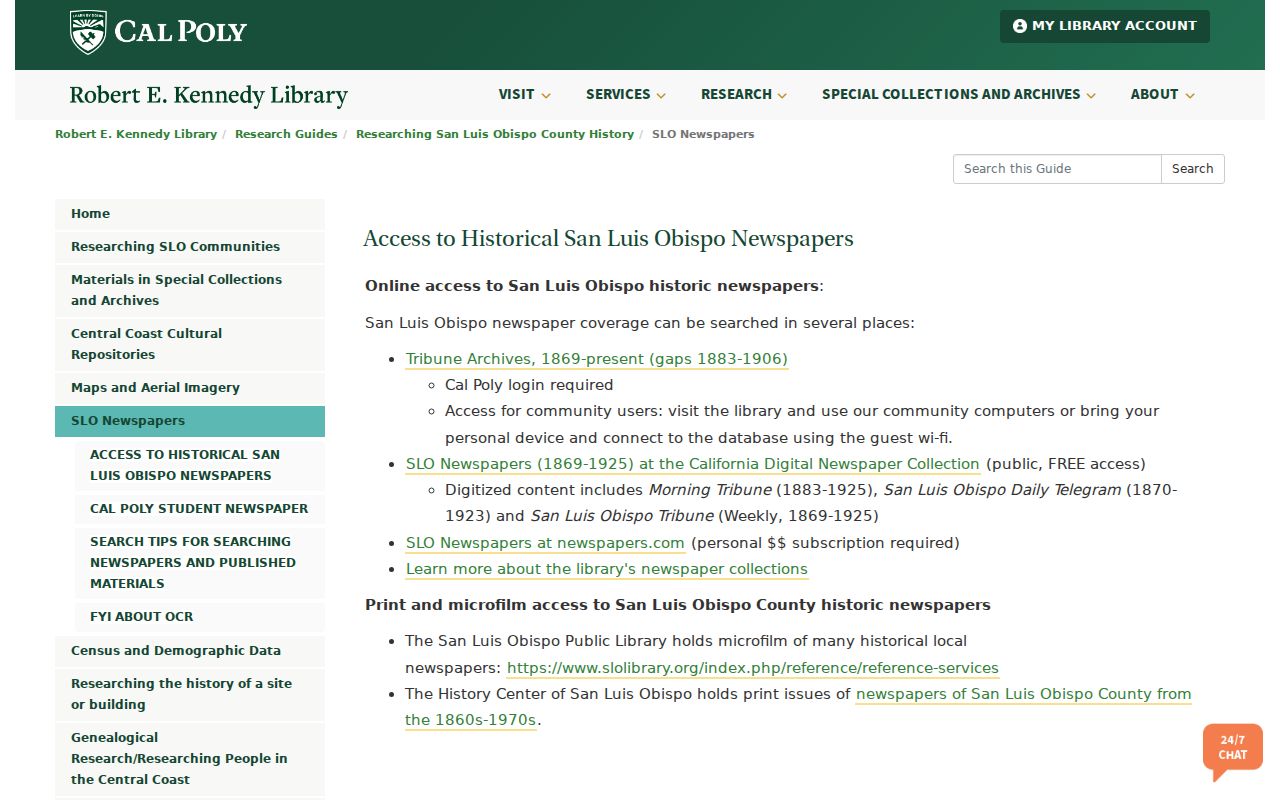
The guide's repository notes help distinguish a free digital issue from a microfilm or onsite collection.
Trace San Luis Obispo Households
A good family-history search moves one edition at a time. Copy the complete entry, including spouse, work, address, status mark, and any alternate spelling. Then use the street section to see who was nearby. Pair the directory year with the closest public census year, and use a deed, permit, newspaper, probate file, or obituary to explain a move or disappearance.
- Choose the strongest starting clue: a known name, address, occupation, spouse, or relative.
- Find the first usable San Luis Obispo city directory edition and copy the abbreviation key before reading entries.
- Follow the name across adjacent available editions, noting every address, spouse, work line, and spelling change.
- Flip to the street or criss-cross section to test the household against nearby names and house numbers.
- Pair the directory bands with the 1940 or 1950 census, then use newspapers, deeds, permits, probate, or obituaries to close gaps.
The federal census is public through 1950 under the 72-year rule, with 1960 opening in 2032. A person who vanishes from a city directory may have moved, died, changed a name, entered service, become unlisted, or simply fallen in a publication gap. The result should preserve that uncertainty.
Cal Poly San Luis Obispo Archives
Cal Poly Special Collections adds student newspapers, yearbooks, photographs, oral histories, architectural collections, and regional manuscripts to the San Luis Obispo city directory shelf. The online student-newspaper corpus covers 1916 through 2011, with gaps from 1933 to 1937 and 1943 to 1945. The reading room has the full run and indexes. Published yearbooks and newspapers can establish a student's or faculty member's historical affiliation, while university records remain subject to FERPA and archival restrictions.
The community collections include the Eto Family Photographs, Ethnic Studies Oral History Collection, Louis Family Papers, Sisters' Inn material, and Filipino-American resources. These sources can restore local people and groups who are missing from a mainstream printed directory. They also provide a way to test alternate names, organizations, and family links rather than relying on one surname.
The Cal Poly student-newspaper collection is the source captured for this archival route.
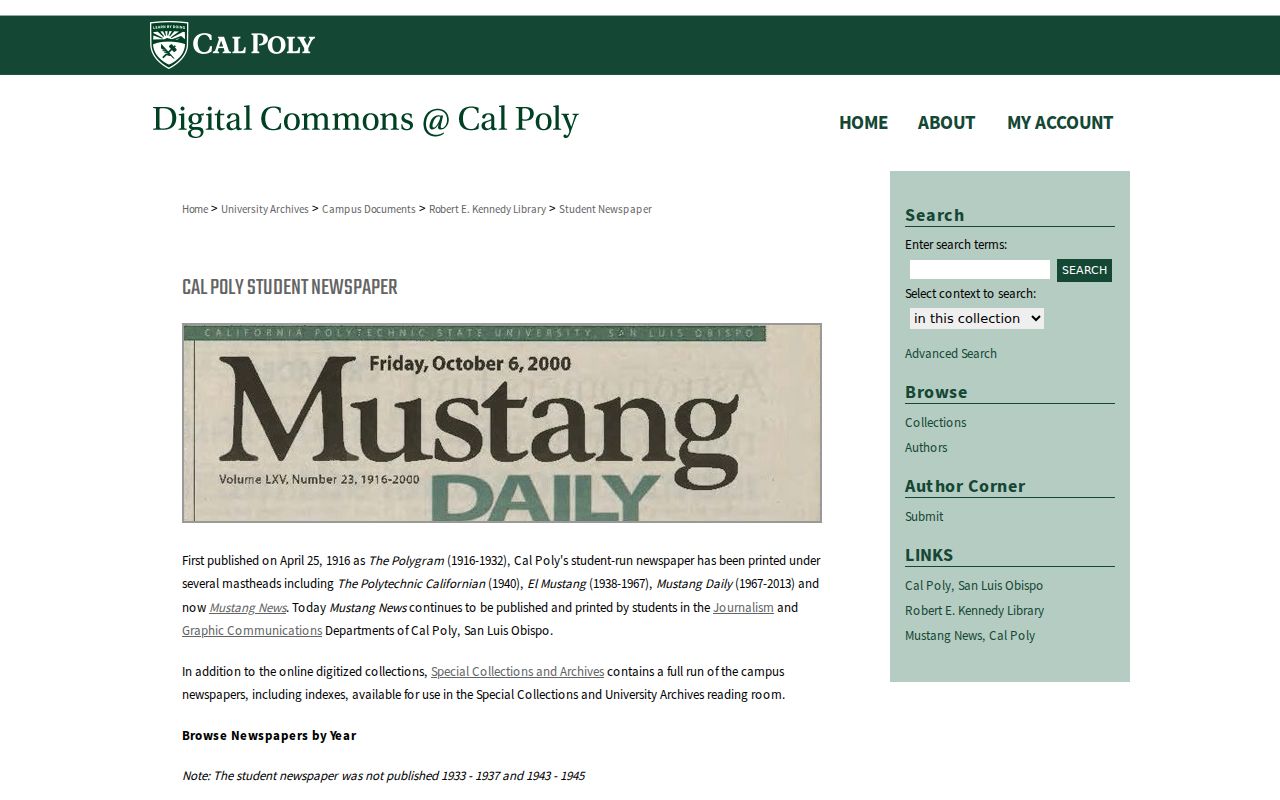
A published student paper can anchor a person to a campus or event without exposing a private current address.
San Luis Obispo Built History
The building-permit collection gives the city directory search a physical timeline. More than 4,000 permits survive from 1906 through 1937, although the archive is incomplete and annual indexes are verified for 1923 and 1928 through 1937. Early permits may be organized by block and lot or by owner rather than by a modern street number. Use a permit to date construction or identify a named applicant, then compare that clue with a directory entry and a Sanborn footprint.
San Luis Obispo's historic districts also shape the search. Downtown's major building boom falls between 1895 and 1910. Chinatown occupies the Palm Street block between Chorro and Morro and became a formal district in 1995. Mill Street carries early twentieth-century revival and Craftsman-era homes. Old Town was established as a district in 1987, while the Railroad district follows the former Southern Pacific yard after the railway's 1894 arrival. These labels guide a source search, but they do not replace a parcel or legal description.
The Cal Poly built-history guide is the source captured for the permit, map, directory, and address workflow.
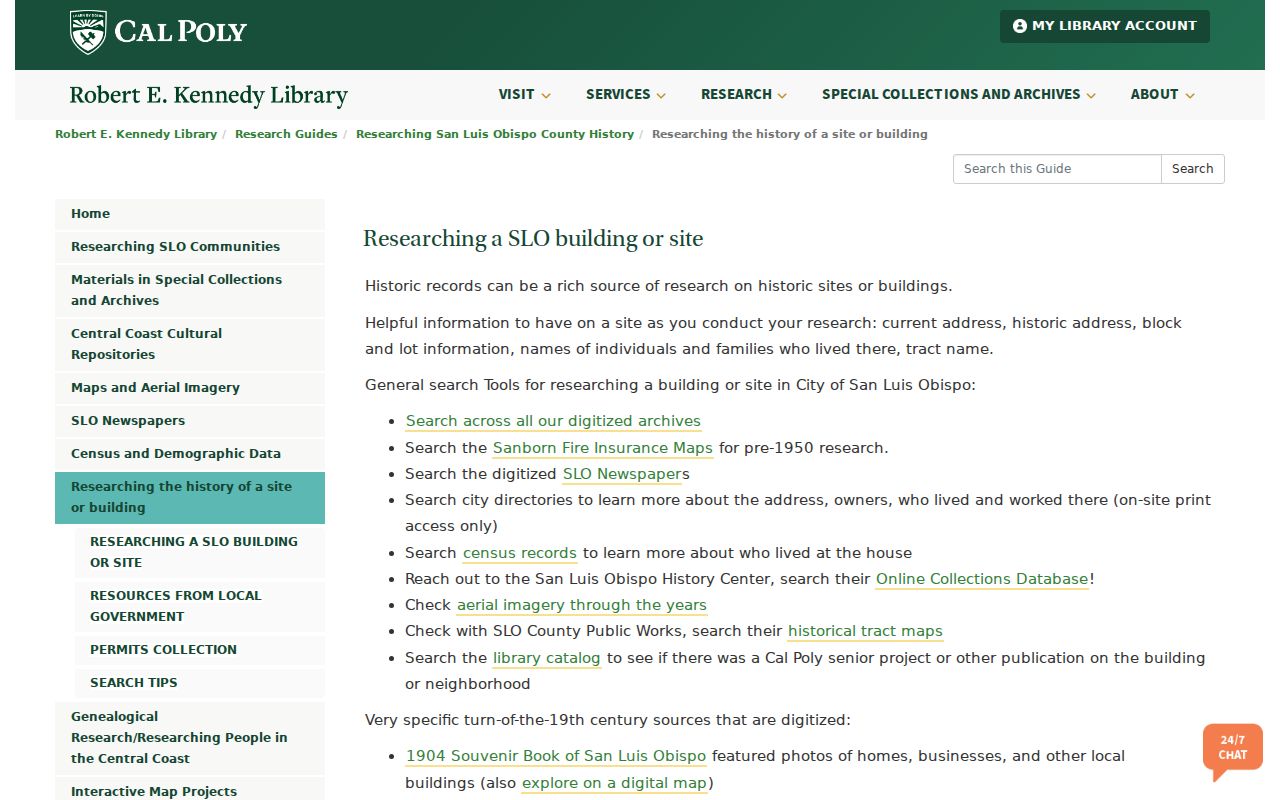
The guide connects the printed city directory to the building and parcel evidence that makes an old address easier to place.
Mission Names Before the Directory
Mission San Luis Obispo de Tolosa, founded in 1772, produced sacramental records before the county's 1850 civil system. Those registers use church jurisdiction and Spanish-era naming, not the street and parcel terms found in a later San Luis Obispo city directory. For a deep family search, bridge the mission or parish entry to county deeds, civil indexes, the federal census, newspapers, and the directory volumes rather than forcing every name into a modern spelling.
Spanish compound surnames, initials, married-name changes, missing marks, transliterations, and trust or entity ownership all affect a directory search. Local history tied to Chumash homeland, mission settlement, Mexican and early American land systems, railroad growth, agriculture, and Cal Poly can place a person in an institution or neighborhood even when a name index is thin.
The first verified directory touching the place is 1875, the first verified local city and county volume is 1901, Polk is cataloged 1942 through 2000, and telephone directories cover 1945 through 1963. Those are separate record-keeping milestones, not one continuous run.